Best Graduation Party Food Ideas for a Crowd (Feed 50+ Without Losing Your Mind)
My son graduated from high school last June, and in the weeks leading up to the party, I had recurring nightmares about food. Not the food itself — the math. Because when you send out graduation party invitations to family, friends, neighbors, your kid’s entire friend group, their parents, your coworkers who watched your kid grow up, and the random cousin who invites herself to everything, the number climbs fast. Our final count was sixty-three people.
Sixty-three people. In my backyard. All of them expecting to eat.
I called my mother in a mild panic and said, “How do I feed sixty-three people without spending $800 or losing my mind?” She laughed the laugh of a woman who has catered every family event since 1987 and said, “You don’t make sixty-three individual meals. You make six big things and let people serve themselves.”
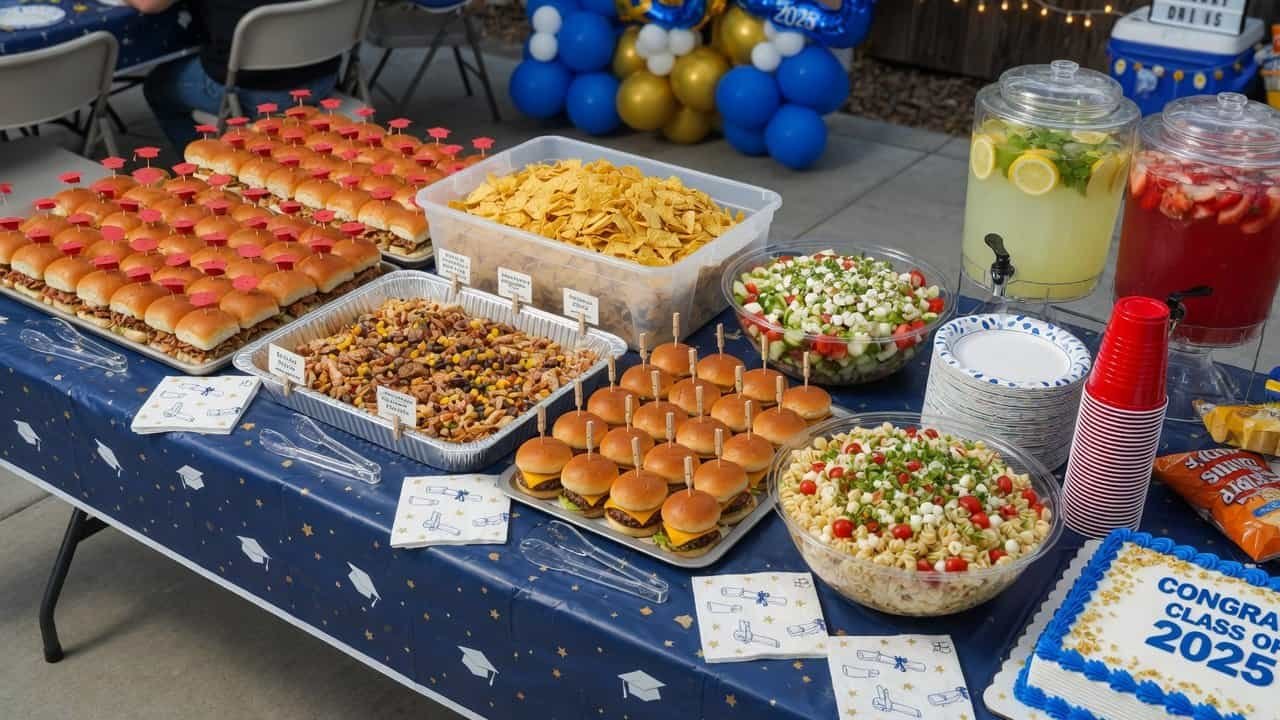
That advice saved my entire graduation party. Six big things. Not sixty-three portions of a complicated recipe. Not a catering bill that costs more than the first semester of college. Six large-format, crowd-friendly, serve-yourself dishes that are easy to make in bulk, easy to keep warm or cold for three hours, and easy for guests to eat while standing in a backyard holding a paper plate in one hand and a diploma-shaped cookie in the other.
The party was a complete success. The food ran out at exactly the right time — toward the end, when people were full and starting to leave, not in the middle when hungry guests were still arriving. The total food cost was $187 for sixty-three people. That is $2.97 per person. My mother was right. She usually is.
This guide contains every food idea, recipe shortcut, quantity calculation, and serving strategy I used — plus a dozen more ideas I have gathered from throwing and attending graduation parties for the past decade. Whether you are feeding 30 people or 100, whether your graduate is finishing kindergarten or medical school, and whether your budget is $100 or $500, this guide will get everyone fed, the graduate celebrated, and your sanity preserved.
Before we get into specific food ideas, let me share the five rules that make feeding a large group manageable instead of maddening. These rules apply whether you are feeding 25 or 150 people, and following them will prevent every common graduation party food disaster I have witnessed over the years.
Rule 1: Serve buffet-style, never plated. A buffet lets guests serve themselves the portions they want of the items they like. No one goes hungry because they got a portion that was too small. No food gets wasted because someone got a portion of something they do not eat. You set up the table once and spend the rest of the party being a host instead of a server. Plated meals require individual assembly, timing, and delivery that is logistically impossible for groups over twenty without hired help.
Rule 2: Choose foods that hold temperature for three hours. A graduation open house typically runs two to four hours, with guests arriving and eating at different times throughout. Your food must be safe and appetizing at the beginning of the window and at the end. Cold foods kept on ice stay safe indefinitely. Hot foods in slow cookers, chafing dishes, or insulated containers stay warm and safe for three to four hours. Foods that require precise temperature — anything that must be served “hot from the oven” — fail at graduation parties because you cannot continuously cook for three straight hours.
Rule 3: Stick to finger foods and handheld items. Guests at graduation parties are standing, socializing, mingling, and congratulating. They are not sitting at a table with a fork and knife. Every food item should be eatable with one hand or manageable on a small paper plate without requiring cutting. Sliders instead of full burgers. Taco cups instead of plated tacos. Skewers instead of bone-in chicken. The handheld format keeps the social flow moving and eliminates the furniture requirement of sit-down dining.
Rule 4: Calculate quantities using the 2/3 rule. Not everyone eats everything. A table of ten dishes does not mean each person eats a full serving of all ten dishes. Calculate quantities for two-thirds of your guest count per dish. If you are expecting 60 people and serving pulled pork sliders, make enough sliders for 40 people — because the other 20 will fill up on tacos, salad, fruit, and dessert instead. This rule prevents massive over-ordering while ensuring no dish runs out prematurely.
Rule 5: Make it the day before. Every dish on your graduation party menu should be either fully prepared the day before and reheated or assembled morning-of, or should require zero cooking (like a fruit platter or a cheese board). The morning of the graduation party is for decorating, setting up tables, getting the graduate dressed, and managing the inevitable emotional chaos of the day. It is not for standing in a kitchen cooking from scratch while guests are arriving in your driveway.
Main Dishes That Feed a Crowd
1. Pulled Pork Slider Station (The Crowd-Feeding Champion)
If I could recommend only one main dish for a graduation party, it would be pulled pork sliders. The reasons are mathematical, practical, and delicious. A single pork shoulder (also called pork butt — same cut, confusing name) weighing eight to ten pounds costs $15 to $25, feeds 35 to 45 people when served on slider buns, and cooks itself in a slow cooker or oven overnight while you sleep. No babysitting. No timing. No stress. You wake up, shred it with two forks, add barbecue sauce, and the main course for your entire party is done before you have finished your morning coffee.
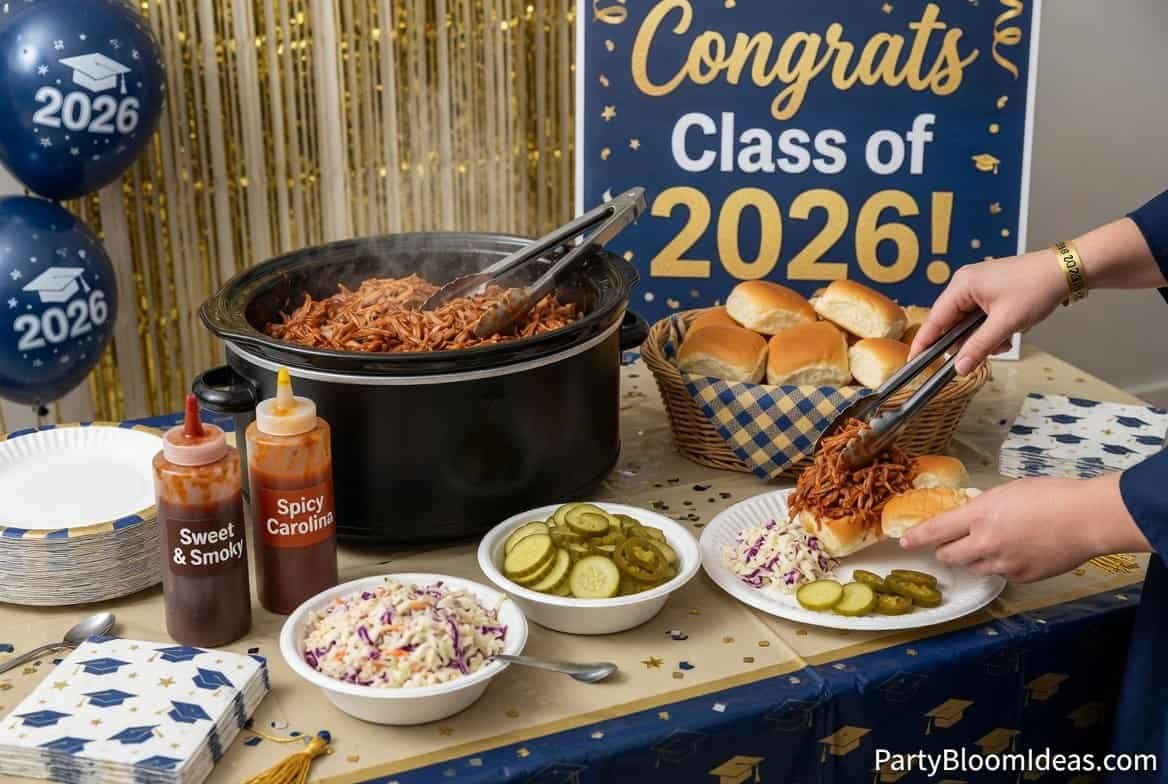
Season the pork shoulder generously with salt, pepper, garlic powder, onion powder, smoked paprika, and brown sugar the night before. Place it in a large slow cooker, add half a cup of apple cider vinegar and half a cup of chicken broth, set on low, and let it cook for ten to twelve hours overnight. In the morning, the meat will be so tender it falls apart when you look at it. Shred it directly in the slow cooker using two forks, stir in one cup of your favorite barbecue sauce, and set the slow cooker to warm. It will hold at perfect serving temperature for four to six hours.
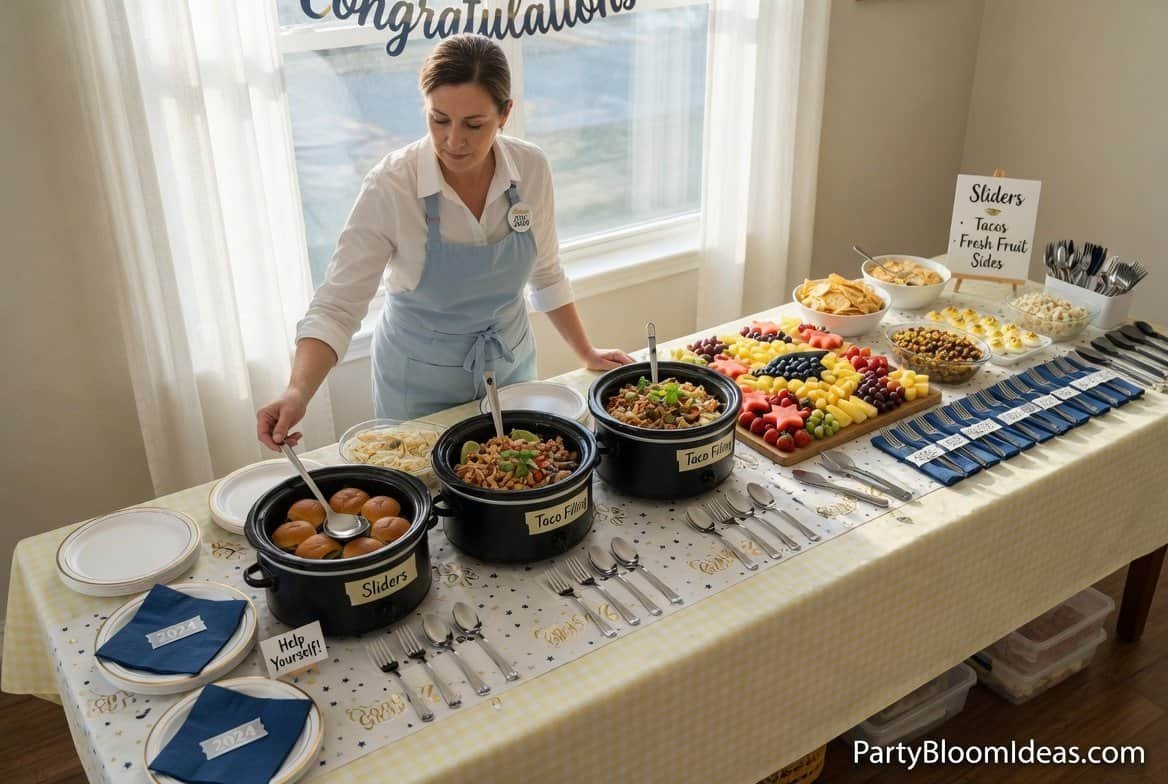
Set up a slider station with a basket of Hawaiian sweet rolls (the twelve-packs that split into individual rolls — buy four packs for $12), the slow cooker of pulled pork with a serving spoon, and a spread of toppings: creamy coleslaw in a bowl, sliced pickles, extra barbecue sauce (offer two varieties — a sweet Kansas City style and a tangy Carolina style), and sliced jalapeños for the heat lovers.
Guests build their own sliders — split a roll, pile on the pork, add their preferred toppings, and walk away with a handheld sandwich that rivals any barbecue restaurant. The total cost for 40 sliders including buns and toppings: approximately $35 to $45. Per person cost: less than $1.
The pulled pork can be made up to two days in advance, refrigerated, and reheated in the slow cooker on party day. It actually tastes better the second day as the flavors continue to develop in the sauce. This make-ahead capability is why pulled pork is the undisputed king of crowd-feeding — you can have the main course completely done 48 hours before your party starts.
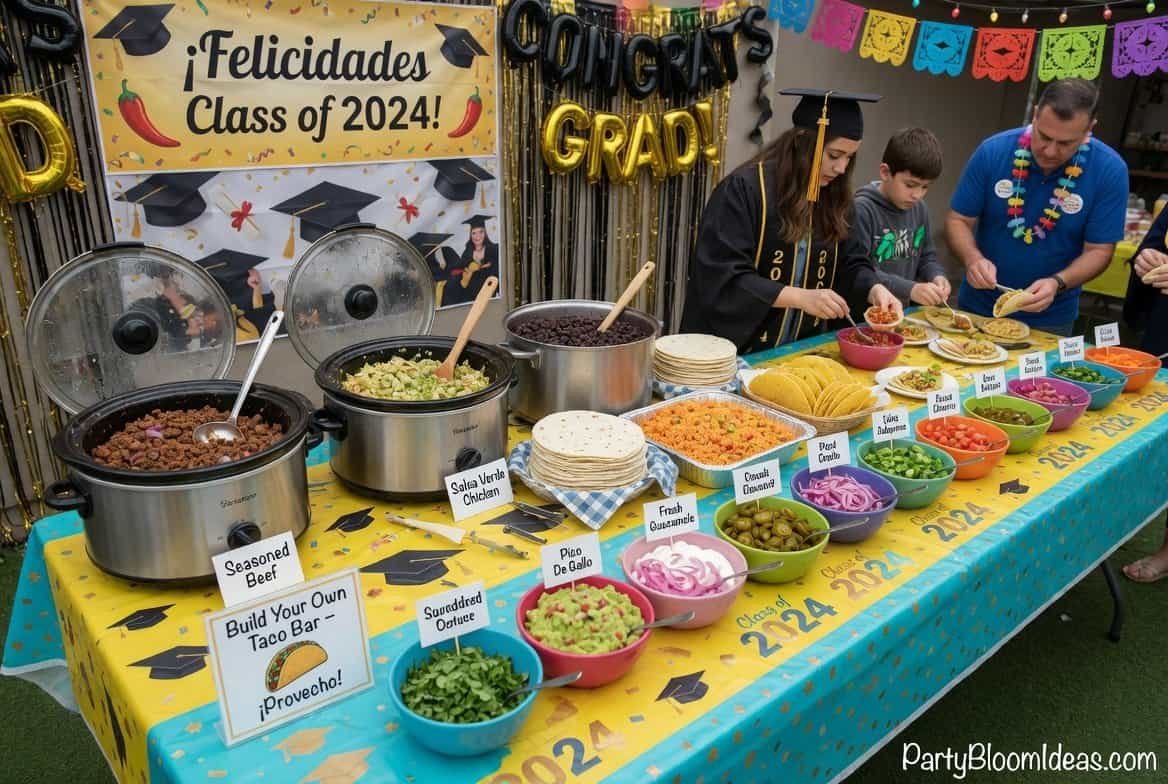
2. Build-Your-Own Taco Bar (Everyone’s Favorite)
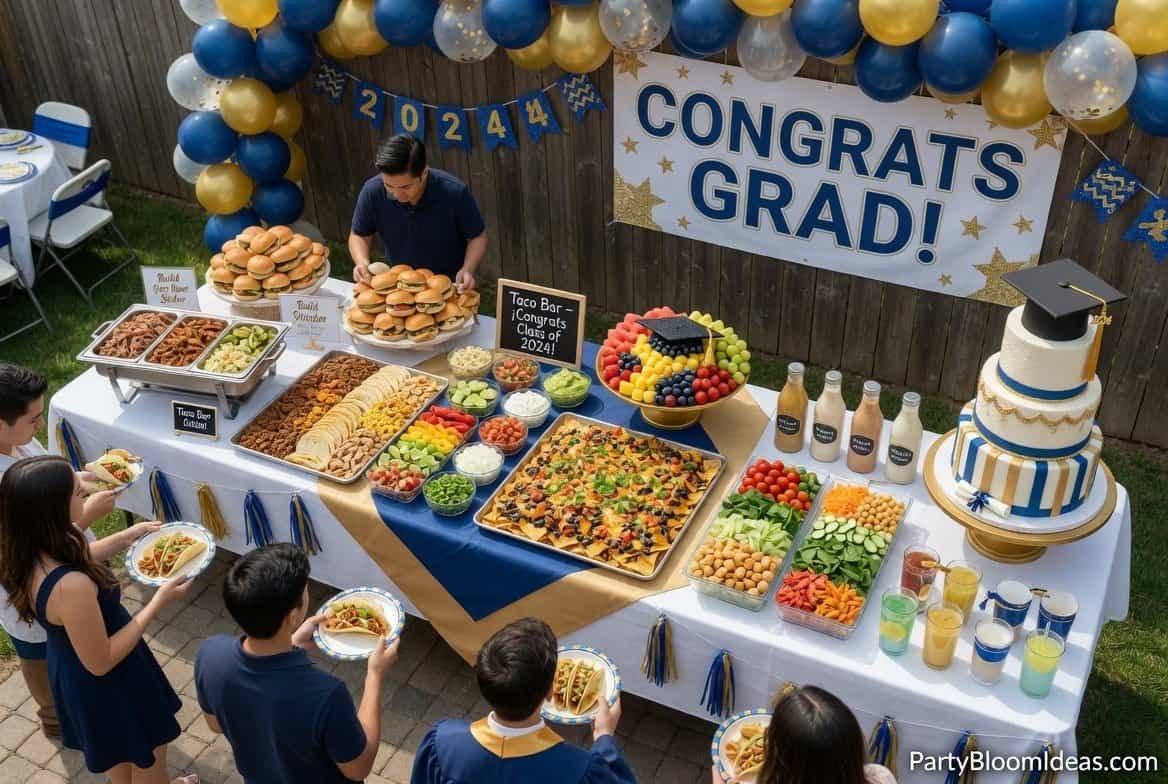
A taco bar at a graduation party is the food equivalent of a greatest hits album — everyone finds something they love, nobody complains, and the crowd-pleasing factor is essentially 100 percent across every age group, dietary preference, and pickiness level. It is also one of the cheapest ways to feed a large group because the base ingredients — ground beef, rice, beans — are among the most affordable proteins and starches per serving.
For 50 people, prepare the following quantities. Three pounds of seasoned ground beef ($12 to $15) browned with three packets of taco seasoning. Three pounds of shredded chicken ($10 to $12) cooked in a slow cooker with salsa verde and shredded with forks. Two cans of seasoned black beans ($3) heated with cumin, garlic, and lime juice. Four cups of Mexican rice ($3 in dry rice). These four proteins and bases provide enough variety that every guest builds a different taco.
The shell station: four packs of soft flour tortillas ($8) and three boxes of crunchy corn taco shells ($6). Warm the flour tortillas in a damp towel in the microwave before setting them out wrapped in a clean kitchen towel to stay warm.
The toppings bar is where the taco station becomes a show. Set out twelve to fifteen small bowls in a logical line: shredded lettuce, diced tomatoes, shredded Mexican blend cheese, sour cream, guacamole (six avocados mashed with lime, salt, cilantro — $8), pico de gallo, pickled red onions, fresh cilantro, sliced jalapeños, corn salsa, crumbled cotija cheese, lime wedges, and three hot sauce bottles ranging from mild to devastating.
Label each topping with a small card — especially the spicy items. “Pickled Red Onions” sounds much more appealing than an unidentified bowl of purple things. “Chipotle Hot Sauce — VERY HOT” prevents an unsuspecting grandmother from ruining her afternoon.
Total cost to feed 50 people: $50 to $65. Per person: approximately $1 to $1.30. The taco bar feeds more people per dollar than virtually any other graduation party food format while delivering restaurant-level customization and satisfaction.
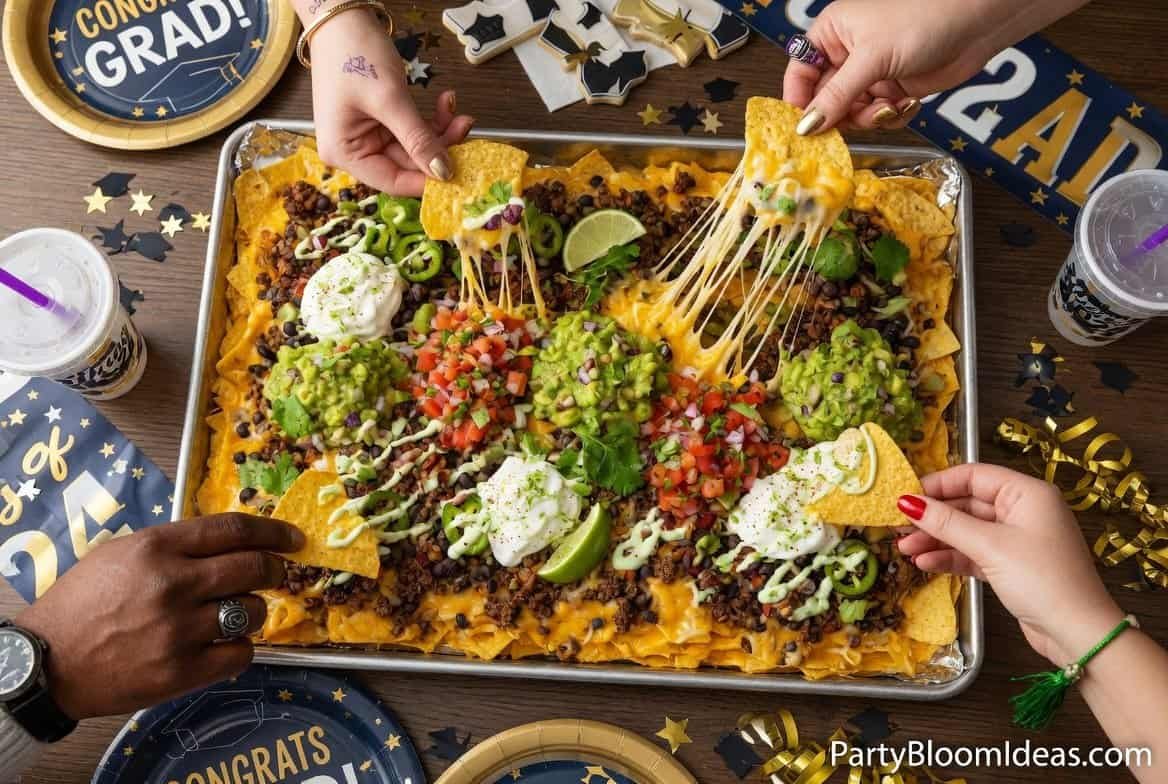
3. Sheet Pan Nachos (Communal and Dramatic)
Sheet pan nachos are the graduation party appetizer that doubles as entertainment because the presentation is inherently dramatic — a massive, steaming, cheese-covered sheet of loaded nachos placed directly on the table for communal grabbing. People gather around, pull chips from the edges, debate which section has the best topping ratio, and bond over the shared experience of eating from the same pan.
For each sheet pan (feeds 8 to 10 people), spread a thick layer of tortilla chips across a large baking sheet. Layer with cooked seasoned ground beef or shredded chicken, black beans, diced jalapeños, and two generous handfuls of shredded Mexican blend cheese. Bake at 400 degrees for 8 to 10 minutes until the cheese is melted, bubbly, and beginning to brown at the edges.
Pull from the oven and immediately top with cold toppings: dollops of sour cream, scoops of guacamole, pico de gallo, sliced green onions, fresh cilantro, and a drizzle of lime crema (sour cream thinned with lime juice). The contrast of hot melted cheese and cold fresh toppings creates a temperature and texture experience that individual nachos from a bag cannot replicate.
For 50 guests, make five to six sheet pans. Stagger the baking — put two in the oven every twenty minutes — so a fresh, hot pan appears on the table throughout the party rather than all at once. The ongoing arrival of fresh nachos keeps the energy high and gives guests a reason to return to the food table multiple times.
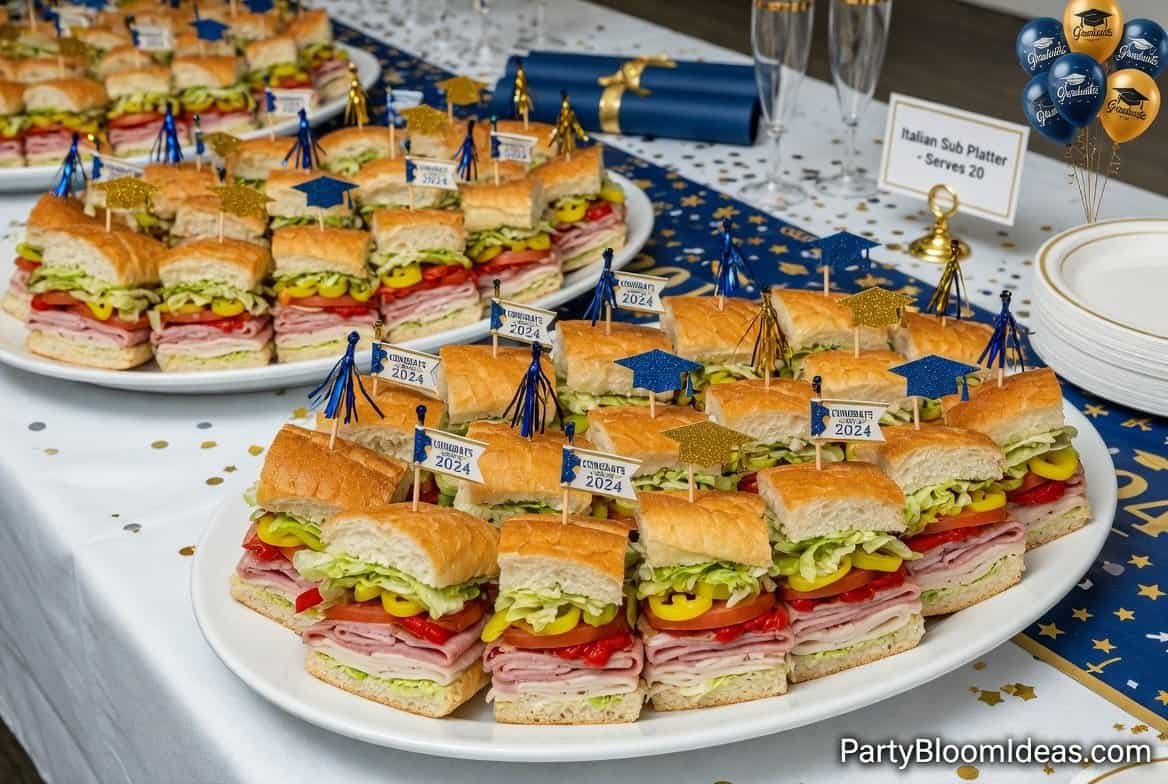
4. Italian Sub Sandwich Platters (Zero Cooking Required)
For hosts who refuse to cook on graduation party day — and honestly, that is a completely valid life choice — Italian sub sandwich platters provide a substantial, satisfying main course that requires zero heat, zero cooking skill, and approximately thirty minutes of assembly. You are essentially building very long sandwiches and cutting them into shareable portions.
Buy three to four Italian sub rolls or French bread loaves (the longest ones you can find — 24 to 36 inches each). Slice each loaf lengthwise. Layer the bottom half with deli meats — salami, ham, turkey, pepperoni, and provolone cheese — in overlapping layers. Add shredded lettuce, sliced tomatoes, red onion rings, banana pepper rings, and a drizzle of Italian dressing and red wine vinegar. Season with oregano, salt, and pepper. Place the top half of the bread, press down firmly, and cut into two-inch portions.
Arrange the portions standing upright on a large platter so the cross-section of layered meats, cheese, and vegetables is visible — this presentation looks like a professional catering display and lets guests see exactly what is in each piece before choosing.
Three 36-inch subs cut into 2-inch portions produce approximately 54 pieces — enough for 50 guests to each have one piece alongside other buffet items. Total cost: $35 to $50 depending on deli meat quality. The subs can be assembled up to four hours before serving and stored wrapped in the refrigerator until display time.
Side Dishes and Snacks
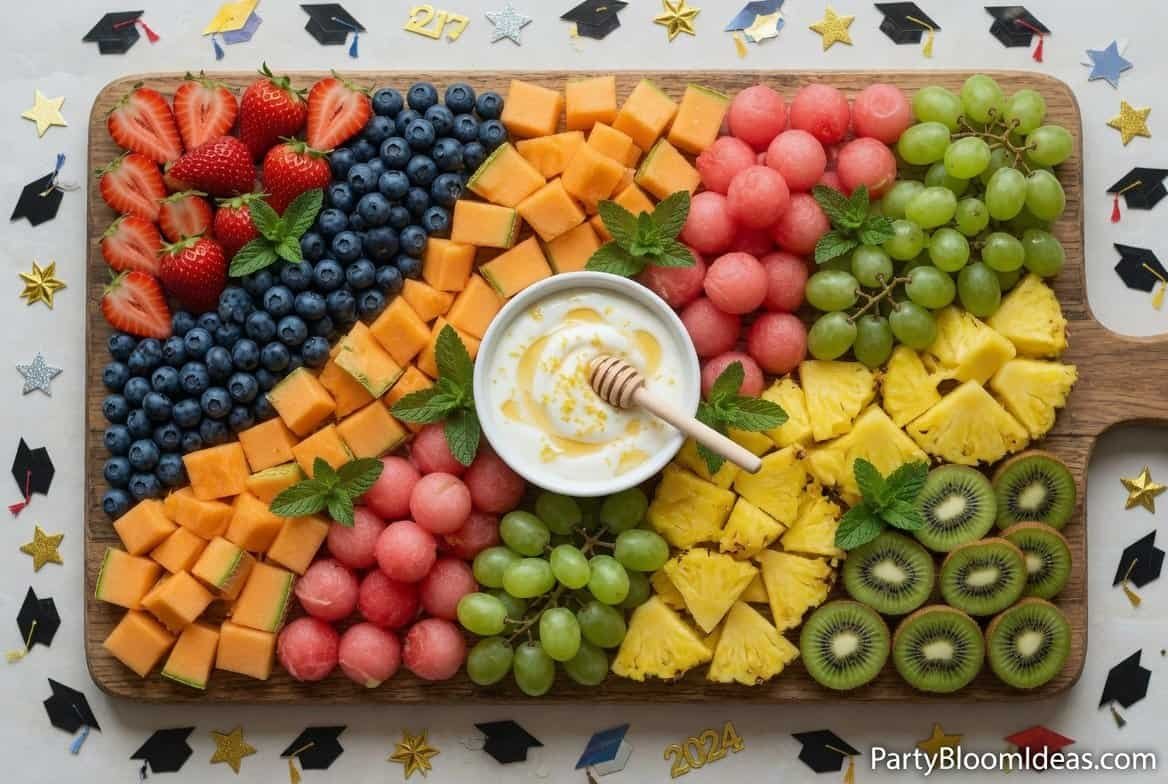
5. Fruit Display With Yogurt Dip
A large fruit display is the one food item that every single graduation party needs, regardless of what else is on the menu. It is fresh, colorful, healthy, naturally gluten-free and dairy-free, universally liked by every age group, and it provides the critical visual element of color and freshness on a buffet table that might otherwise be dominated by beige and brown foods.
For 50 guests, buy approximately $20 to $25 worth of seasonal fruit: two pints of strawberries (sliced in half), two pints of blueberries, one pint of raspberries, one large cantaloupe (cubed), half a watermelon (cubed or balled), two bunches of grapes (separated into small clusters), one pineapple (cored and chunked), and three kiwis (peeled and sliced). The variety of colors — red, blue, orange, pink, green, gold, brown — creates a rainbow that makes the display look abundant and festive.
Arrange the fruit on the largest platter, board, or tray you own. Group each fruit type together rather than mixing randomly — the color-blocked arrangement looks deliberate and professional rather than like a fruit salad that fell onto a plate. Fill every gap with berries. Tuck a few mint sprigs between sections for color contrast and fragrance.
Place a bowl of honey yogurt dip in the center or to one side: two cups of vanilla Greek yogurt mixed with two tablespoons of honey and half a teaspoon of vanilla extract. The dip gives guests a reason to eat more fruit and adds a creamy, sweet element that makes the display feel like a dessert station as much as a healthy option.
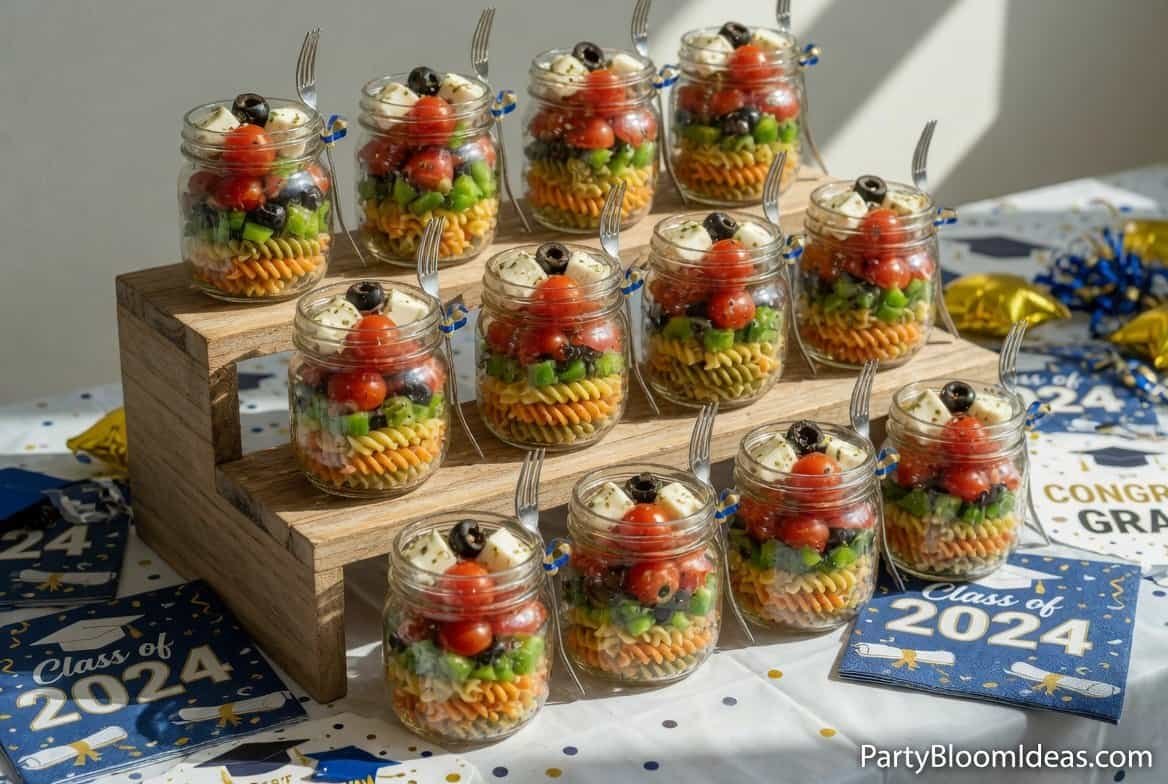
6. Pasta Salad in Mason Jars (Individual Portions)
Instead of a large bowl of pasta salad that requires serving spoons, plates, and forks, serve individual portions in small mason jars or clear plastic cups that guests grab and eat directly from the container. Each jar is a self-contained, pre-portioned serving that eliminates the mess, the awkward scooping, and the cross-contamination concerns of a communal bowl.
Make a large batch of your favorite pasta salad the day before — rotini with Italian dressing, cherry tomatoes, diced bell peppers, olives, cubed mozzarella, and fresh basil is the classic combination that pleases everyone. Refrigerate overnight so the flavors meld. The morning of the party, spoon the salad into small jars or cups, filling each about three-quarters full. Set them out on a tray with small forks or just let people eat them with their fingers — the rotini shape makes pasta salad surprisingly finger-food-friendly.
For 50 guests, make enough to fill 35 to 40 jars (using the two-thirds rule — not everyone will take one). A standard batch uses two pounds of pasta ($2), a bottle of Italian dressing ($3), and approximately $8 to $10 in vegetables and cheese. Total: $13 to $15 for 40 servings.
The presentation of 40 mason jars filled with colorful pasta salad arranged on a tiered display or a large tray is visually spectacular — it looks like a catering company prepared individual portions, and guests feel like they are receiving something curated rather than scooping from a bowl.
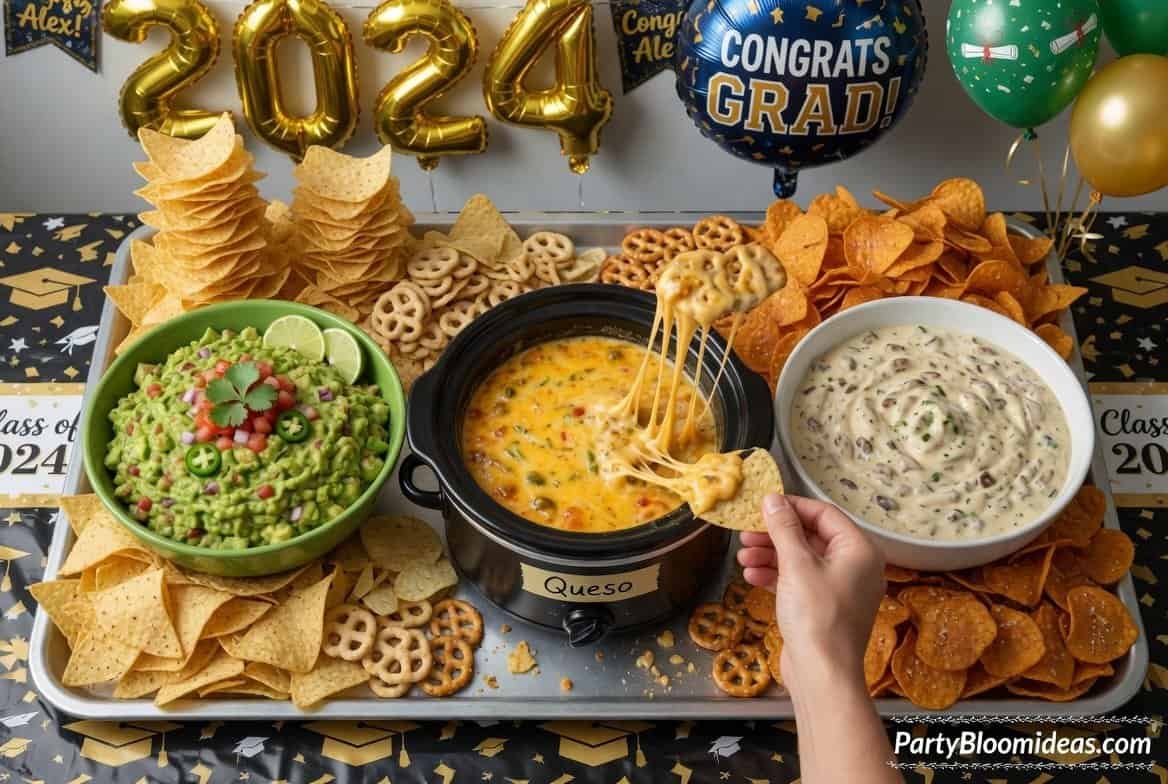
7. Chip and Dip Trio Station
A chip and dip station is the graduation party food that nobody plans as the star but quietly becomes the most visited spot on the table — because people return to it five, six, seven times throughout the party for “just one more chip” that turns into fifteen more chips every single time.
Set up three large bowls of dips in a row: classic guacamole (fresh, chunky, loaded with lime and cilantro), queso dip (melt Velveeta with a can of Rotel diced tomatoes for the most addictive queso on earth), and French onion dip (mix sour cream with onion soup mix — absurdly simple, absurdly good). Surround the three dip bowls with a mountain of chips — tortilla chips for the guac and queso, ridged potato chips and pretzel crisps for the French onion.
For 50 guests, make approximately two cups of each dip ($15 to $18 total) and buy four to five large bags of assorted chips ($10 to $12). The chips will need refilling once during a three-hour party — have backup bags ready in the kitchen so you can dump a fresh mountain onto the platter when the first supply runs low.
Keep the queso warm in a small slow cooker on the “warm” setting so it stays liquid and dippable throughout the party. Cold queso solidifies into a sad, thick paste that nobody wants to eat. Warm queso stays smooth, melty, and irresistible — and the small slow cooker means you never have to reheat it manually.
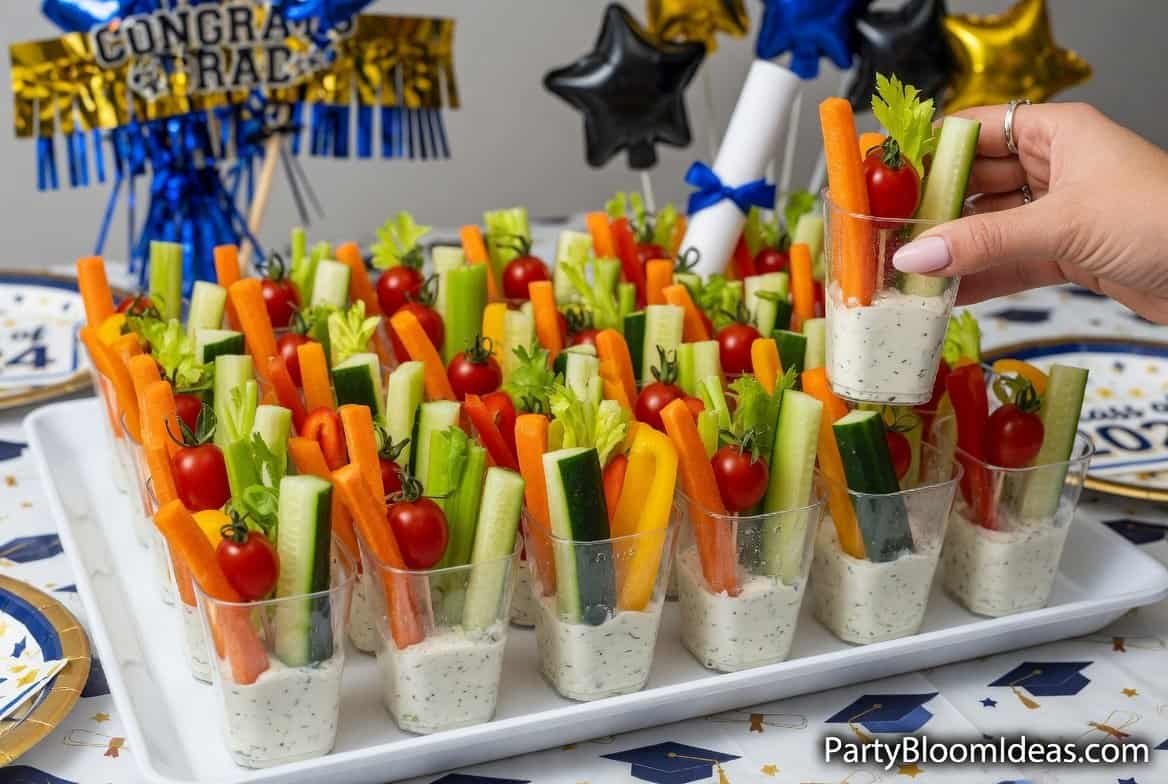
8. Veggie Cups With Ranch (Grab-and-Go Healthy Option)
Individual veggie cups solve the eternal problem of communal veggie trays at parties — nobody wants to be the person double-dipping a half-bitten carrot into the shared ranch bowl. Individual cups eliminate the shared dip issue entirely and create a grab-and-go portion that guests can carry and eat while socializing.
Spoon two tablespoons of ranch dressing into the bottom of each clear plastic cup. Stand vegetable sticks upright in the ranch — carrot sticks, celery sticks, cucumber spears, bell pepper strips, and cherry tomatoes. The vegetables stand up like a colorful bouquet in each cup, and guests dip downward into their own personal ranch supply.
For 50 guests, prepare 35 cups (two-thirds rule). Buy a bag of baby carrots ($2), a bunch of celery ($2), two cucumbers ($2), three bell peppers ($4), a pint of cherry tomatoes ($3), and two bottles of ranch dressing ($4). Total: approximately $17 for 35 individual veggie cups. The assembly takes about twenty minutes and can be done the morning of the party.
Display the cups standing upright on a tray, packed close together so they support each other. The visual of thirty-five cups with colorful vegetables standing at attention like a vegetable garden is both appetizing and impressive — and the individual portioning means zero food waste because no one takes a cup they do not intend to eat.
Desserts and the Graduation Cake
9. The Graduation Cake (Centerpiece of the Party)
The graduation cake is the emotional centerpiece of the entire celebration — the physical object that everyone gathers around for photos, that the graduate cuts ceremonially while family cheers, and that represents the sweet culmination of years of hard work. It needs to look good, taste good, and photograph well. It does not need to cost $200.
The $10 homemade option: Bake a half-sheet cake from two boxes of cake mix ($3), frost with two cans of frosting in the graduate’s school colors ($4), and top with a graduation cap cake topper from the dollar store ($1) and a “Congrats [Name]!” message piped in contrasting frosting or written on a piece of cardstock. Total: $8 to $10. A half-sheet cake serves 40 to 48 people.
The $30 grocery store option: Order a half-sheet cake from your grocery store bakery one to two weeks in advance. Specify the school colors for the frosting and border, request “Congratulations [Name] — Class of 2026” written on top, and ask for a graduation cap or diploma decoration. Grocery store sheet cakes cost $25 to $35, serve 48, and taste perfectly good.
The $50-$80 bakery option: For a more polished cake, order from a local bakery. Specify a two-tier design in school colors with a graduation cap topper and the graduate’s name. A two-tier cake serves 40 to 60 people and creates a more dramatic visual centerpiece than a flat sheet cake.
Regardless of the source, display the cake on a dedicated table or elevated cake stand — not crammed between the taco bar and the chip bowl. The cake table should have its own small decorations: a framed photo of the graduate (bonus points for a side-by-side of kindergarten and senior year), a few flowers in school colors, and the cake on a stand or pedestal that gives it visual height and importance.
10. Dessert Bar With Multiple Small Treats
Instead of relying solely on the graduation cake for dessert, build a dessert bar with four to five small-format treats that give guests variety and create a visually spectacular sweets display. The dessert bar becomes a destination — guests return multiple times throughout the party trying different items, and the table itself photographs beautifully with its variety of colors, textures, and heights.
Cupcakes in school colors (24 cupcakes from a box mix, $6): Frost half in one school color and half in the other. Top each with a small “2026” pick or a fondant graduation cap.
Cookie platter (3 dozen sugar cookies, $8): Cut into graduation-themed shapes — caps, diplomas, stars, the number “26” — and decorate with royal icing in school colors. Make these two days ahead and store in airtight containers.
Brownie bites (2 pans cut into 1-inch squares, $5): Rich, fudgy, universally loved, and utterly simple. Dust with powdered sugar for a polished look.
Chocolate-dipped strawberries (20 berries, $8): Dip in chocolate and drizzle with white chocolate or school-colored melting wafers. These always disappear first because they feel special and indulgent.
Candy bar in school colors (assorted candies, $10): Fill small bowls or jars with candies that match the school colors — M&Ms sorted by color, gummy bears, jelly beans, Hershey’s Kisses, wrapped hard candies. Guests scoop candy into small bags as both a dessert and a take-home party favor.
Arrange everything at varying heights — cake stands, stacked books covered in fabric, overturned bowls as risers — so the dessert bar has visual depth and dimension rather than everything sitting flat at the same level.
Full dessert bar (cake + cupcakes + cookies + brownies + candy)
75
$55
Drinks (lemonade, water, soda)
75
$20
TOTAL
$300
Drinks That Serve Themselves
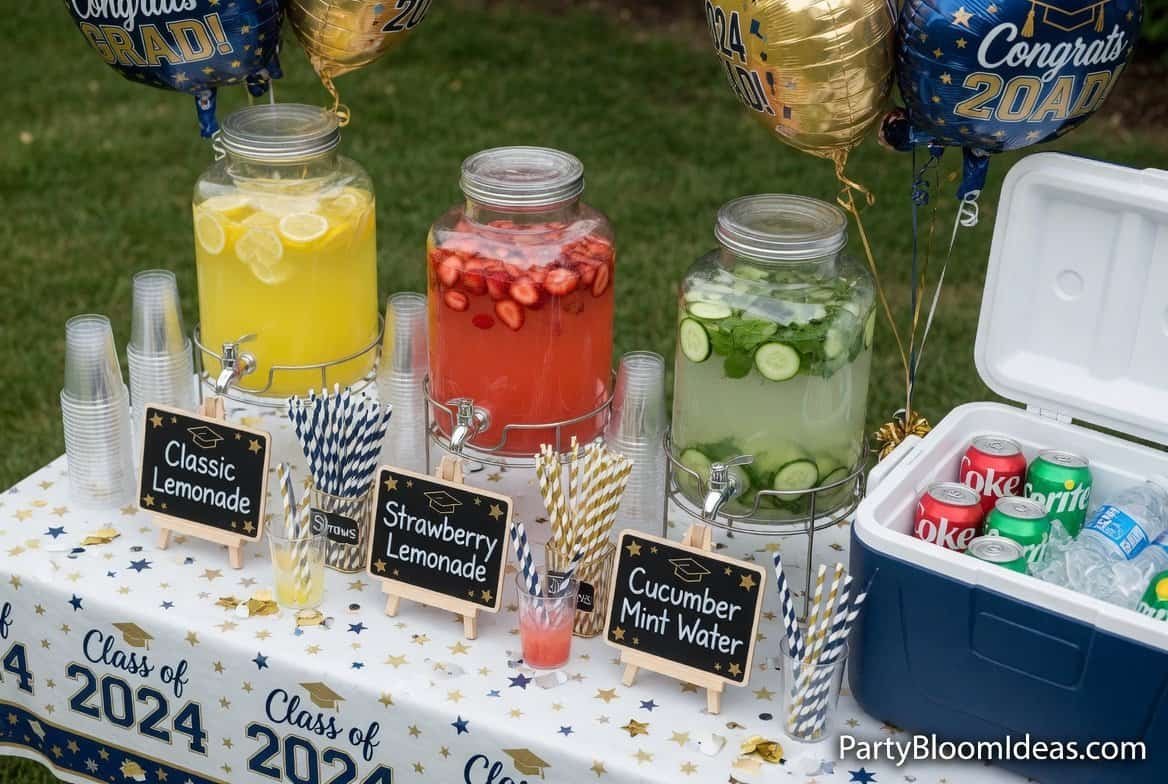
11. Infused Lemonade Dispensers
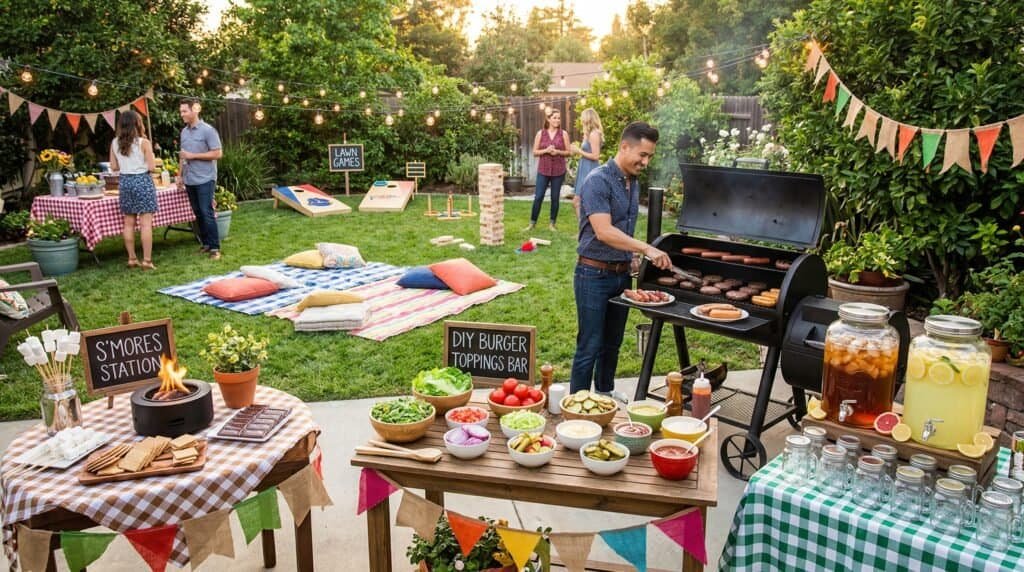
Set up two to three large glass beverage dispensers with different lemonade flavors — classic lemonade, strawberry lemonade (blend strawberries into the lemonade), and cucumber mint water for a non-sweet option. The glass dispensers look elegant, keep drinks cold with added ice, and allow guests to serve themselves without anyone needing to pour drinks or manage a beverage station.
For 50 guests over three hours, prepare approximately two gallons of each flavor (six gallons total). Each gallon costs approximately $2 in lemons, sugar, and fruit additions. Position the dispensers on a dedicated drink table with a stack of clear cups, paper straws in school colors, and a small sign labeling each flavor.
Add a cooler of bottled water and canned sodas beside the lemonade station for guests who prefer those options. A bag of ice in a large tub with drinks buried inside keeps everything cold for the entire party without any management from the host.
Practical Tips From Someone Who Has Done This
Timing Your Prep (The 3-Day Plan)
Three days before: Shop for all non-perishable items. Buy paper plates, napkins, cups, utensils, serving trays, and tablecloths. Buy canned goods, dry pasta, chips, candy, and any shelf-stable ingredients.
Two days before: Shop for perishable items — meat, produce, dairy, bakery items. Season and start the pulled pork in the slow cooker overnight. Bake cookies and brownies. Make pasta salad.
One day before: Shred the pulled pork and refrigerate. Chop all vegetables for the taco bar, fruit display, and veggie cups. Make dips. Assemble sub sandwiches and wrap tightly. Frost cupcakes. Dip strawberries in chocolate. Set up tables and decorations.
Morning of: Reheat pulled pork in slow cooker. Arrange the fruit display. Assemble veggie cups. Fill lemonade dispensers. Set out all food stations. Set out the cake. Put chips in bowls. Take a deep breath. You are ready.
How to Set Up the Buffet Table
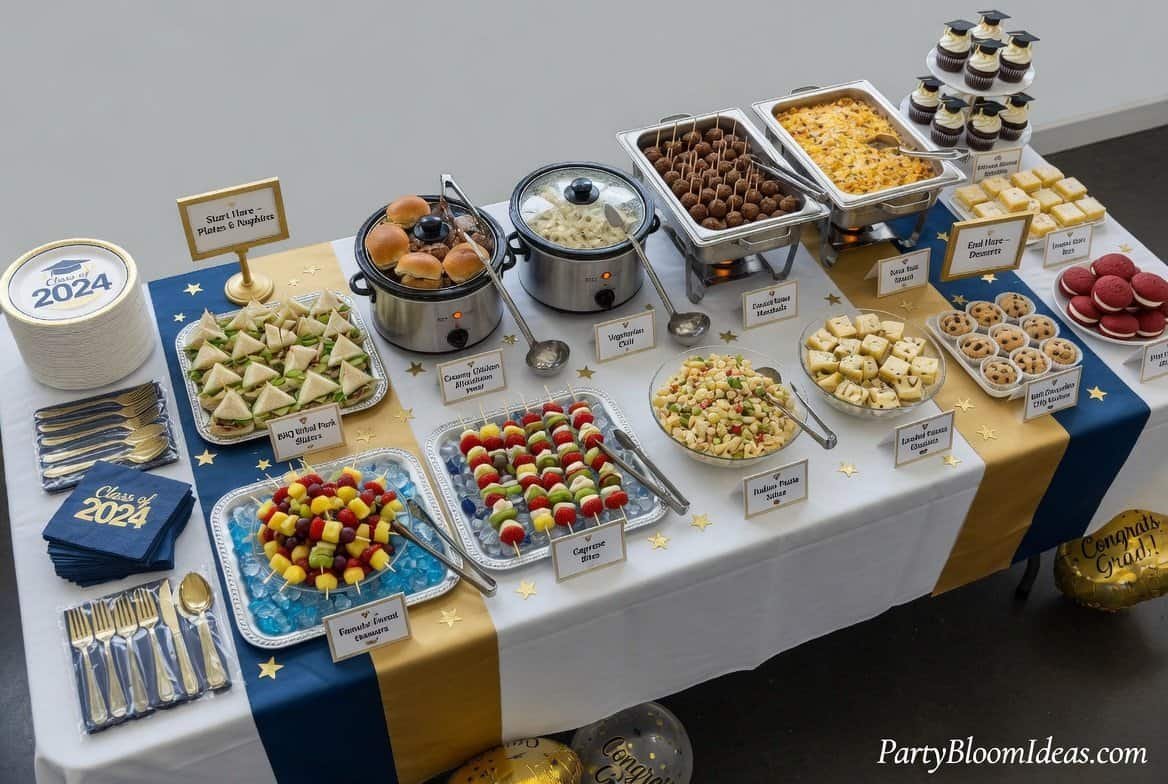
Arrange food in a logical flow that guides guests from start to finish: plates and napkins first, then main dishes (sliders, tacos), then sides (fruit, veggies, pasta salad, chips), then drinks at the end or on a separate table. The flow prevents traffic jams and ensures guests pick up a plate before reaching the food — without a plate in hand first, people awkwardly grab food and look for somewhere to put it.
Place utensils (fork and napkin) at the END of the buffet line, not the beginning. If guests pick up a fork first, they carry it through the entire line while trying to serve themselves one-handed. Utensils at the end mean both hands are free for serving, and the fork and napkin are the last things grabbed before walking away.
Frequently Asked Questions
How much food do I need per person for a graduation party?
Plan for 6 to 8 pieces or bites of food per person over a three-hour open house. This breaks down to approximately one serving of a main dish (two sliders OR two tacos), one serving of a side (fruit, pasta salad, or veggie cup), unlimited chips and dip, one drink, and one dessert. Using the two-thirds rule per dish (not everyone eats every item) prevents over-buying while ensuring nothing runs out.
What is the cheapest way to feed a graduation crowd?
Pulled pork sliders are the most cost-effective main dish at under $1 per person. A taco bar is second at approximately $1.30 per person. Homemade sheet cake is the cheapest dessert at $10 for 48 servings. A fruit display and chips-and-dip round out the cheapest complete menu at approximately $2 to $3 per person total.
Can I make all the food the day before?
Yes — and you should. Pulled pork improves overnight. Pasta salad needs overnight marinating. Cookies and brownies stay fresh for two days in airtight containers. Dips hold well overnight refrigerated. Sub sandwiches can be assembled and wrapped the night before. The only items that should be assembled morning-of are the fruit display (to prevent browning) and the veggie cups (to keep vegetables crisp).
Should I hire a caterer for a graduation party?
If your budget allows and your guest count exceeds 75 to 100, catering can reduce stress significantly. However, for groups under 75, the food ideas in this guide are specifically designed to be self-catered by one or two people with minimal cooking skill. The total cost of self-catering is typically one-third to one-quarter of professional catering for the same guest count.
What time should I serve food at a graduation open house?
Set the food out thirty minutes before the official start time so early arrivals have something to eat immediately. Refresh hot items (pulled pork, queso) every 90 minutes. Replenish chips and depleted items continuously. Keep the dessert table covered until one to two hours into the party so guests eat main food first. The food should be available for the entire duration of the open house, not served at a specific mealtime.
How do I handle dietary restrictions?
The buffet format naturally accommodates most restrictions. A taco bar provides vegetarian options (beans, rice, veggies) alongside meat options. The fruit display and veggie cups are naturally vegan and gluten-free. Label any common allergens — “Contains Dairy,” “Contains Gluten,” “Nut-Free” — on small cards in front of each dish so guests with allergies can make informed choices without having to ask.
Feeding a crowd feels impossible until you do it once. Then you realize the secret was never culinary skill or a massive budget — it was big pots, simple recipes, and the confidence to set out a table of food and trust that people will feed themselves happily.
Your graduate did something hard. They showed up every day for years, even when they did not want to, and they finished. The least you can do is show up with a slow cooker of pulled pork, a taco bar that feeds an army, and a cake that says their name in frosting.
That is enough. That is more than enough. That is a celebration.
Pin this guide and start planning the graduation party your grad deserves. Visit PartyBloomIdeas.com for more party food ideas for every celebration.
Related articles:
The Ultimate Guide to Planning a Birthday Party on a Budget
30 Best Summer Party Ideas for the Ultimate Backyard Bash
25 Party Food Ideas That Are Easy, Cheap, and Crowd-Pleasing
How to Make a DIY Balloon Arch (Step-by-Step Guide)
Cinco de Mayo Party Ideas: The Complete Fiesta Guide
Maya is the founder of PartyBloomIdeas.com. She specializes in honest,
budget-friendly party advice covering DIY decorations, themed parties,
bridal showers, baby showers, birthdays, and seasonal events.