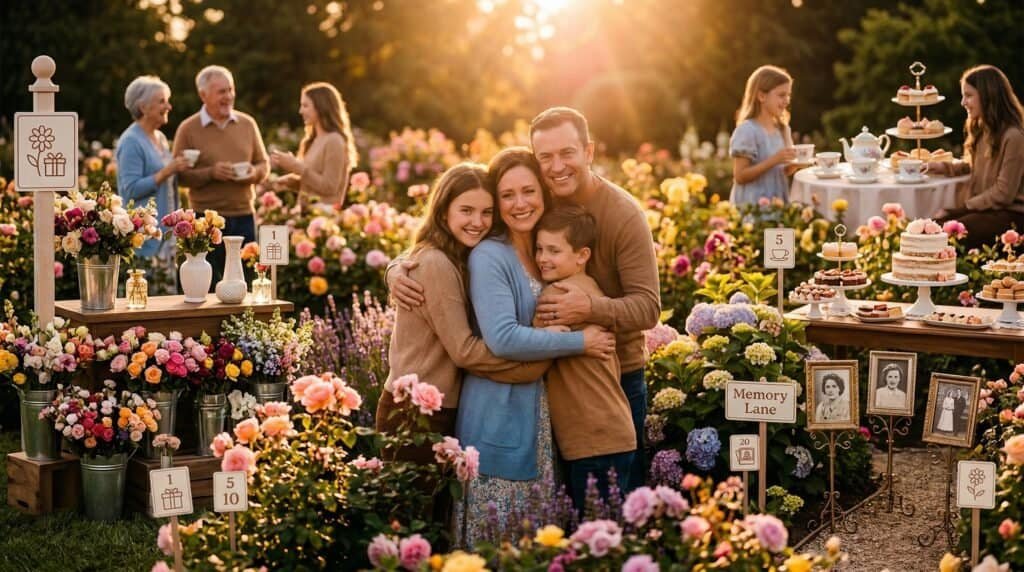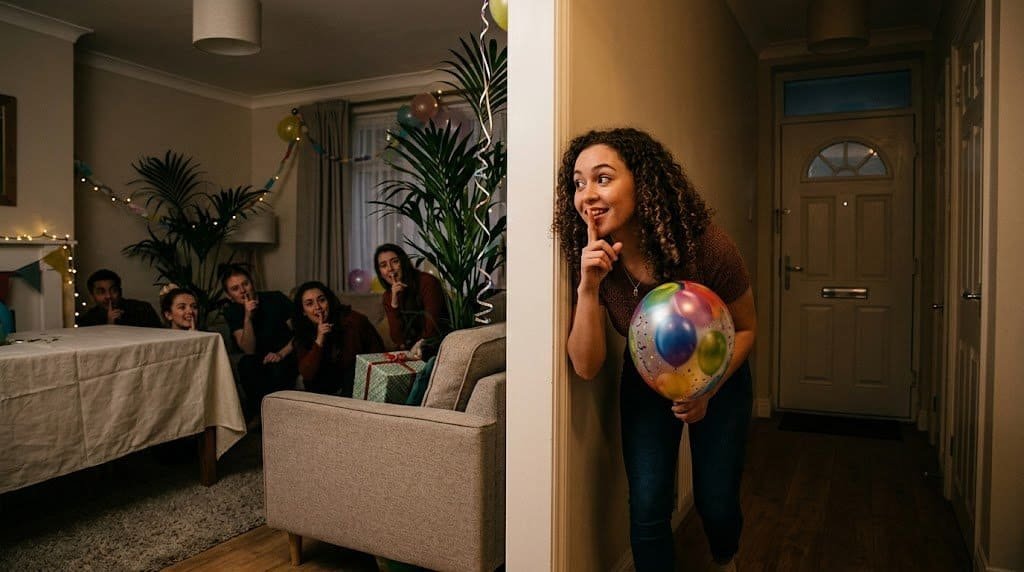
The moment Emma’s husband Daniel walked through the back gate, everything stopped. One second: low chatter, soft music, the smell of jasmine from Emma’s planters mixing with something savory drifting from the kitchen. The next second: twenty-eight people — his college roommates, his sister who’d flown in from Denver, neighbors he’d known for a decade — all standing in the yard with drinks raised.
He stopped. Pressed his hand to his mouth. For a full ten seconds, he didn’t say a single word.
I was the lookout. I’d been stationed near the front gate for forty minutes, phone in hand, watching for headlights. When Daniel’s car turned onto the street, I texted Emma two words: They’re here. She signaled the group. The music dropped. The lights went low. And then he walked in.
That was a surprise party done right — and if you’re wondering how to throw a surprise party, this is exactly the kind of reaction you’re hoping for. I can tell you, it didn’t happen by accident. Emma started planning eight weeks out. She ran a tight inner circle of four people. She drilled the decoy driver on what to say if Daniel asked questions. She put “NO SOCIAL MEDIA UNTIL AFTER THE REVEAL” in bold on every invitation.
When learning how to throw a surprise party, attention to detail makes all the difference. Here’s what actually works when you want to throw a surprise party without getting caught — the steps, the strategies, and the mistakes I’ve watched derail genuinely well-intentioned plans.
This guide on how to throw a surprise party will help you create a memorable celebration while keeping every detail under wraps until the big reveal.
What Throwing a Surprise Party Actually Means (And What It Doesn’t)
A surprise party is, at its core, a coordinated act of love. And logistics. Done right, it’s one of the most emotionally resonant things you can give someone. Done wrong, it’s a case study in why some things shouldn’t be improvised.
What it IS:
- A carefully planned sequence of decisions, each one protecting the secret from the one before it
- A commitment to information discipline — who knows what, and when
- A decoy plan that holds up to scrutiny
- A reveal moment that’s visual, emotional, and worth the wait
What it ISN’T:
- A casual “let’s just show up at their place” idea
- Something you plan on Facebook Events
- A situation that gets easier with more people knowing
- A good idea for someone who has ever said they’d hate being surprised
The trick is: information is the enemy of surprise. Every decision — from the first text you send to where guests park their cars — should protect what the guest of honor knows and when they know it.
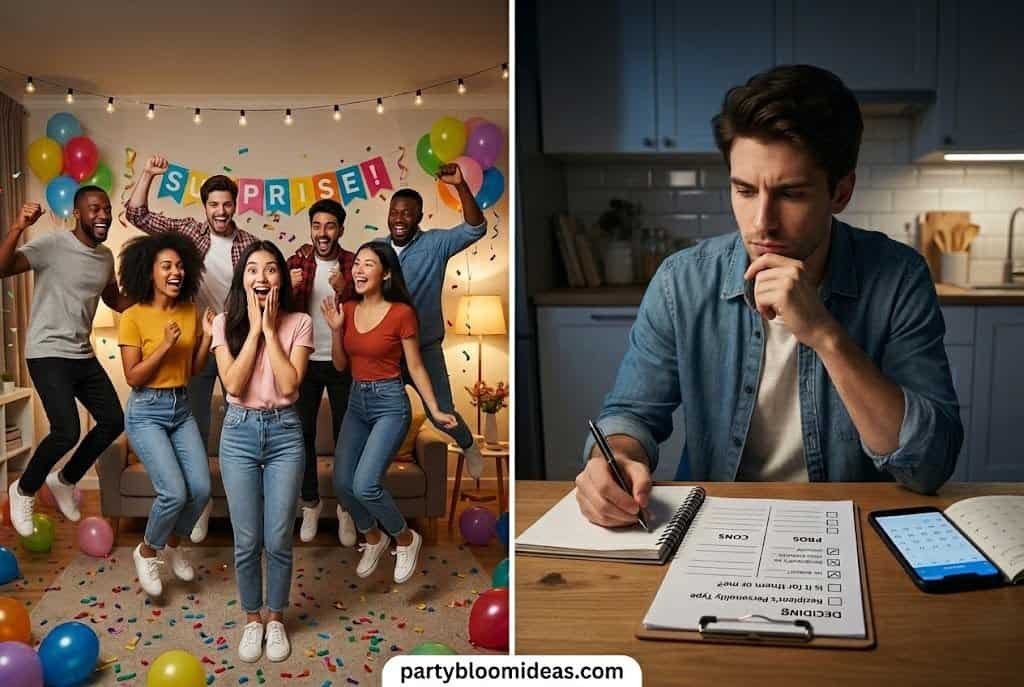
Step 1: Decide If They’ll Actually Like It
Best for: First-time surprise party planners; anyone uncertain about the honoree’s preferences
Before you book a venue or text a single guest, ask two or three people who genuinely know the honoree: “Would she actually want a surprise party?”
This step gets skipped more often than you’d think. And it’s the one that turns a night of love into a night of politely disguised misery.
I attended a birthday party — a close friend of a friend — where the guest of honor walked in to forty people screaming “SURPRISE” and spent the rest of the evening with that particular smile that doesn’t quite reach the eyes. He was gracious. He thanked everyone. He told me on the drive home that he’d mentioned to at least six people over the years that he never wanted a surprise party. Nobody had asked the right people.
Here’s what actually works: quietly poll 3–4 of the honoree’s closest friends using this question: “Be honest — would she love being surprised in front of a big group, or would she secretly hate it?” If two of the four aren’t sure, you have your answer.
According to a 2023 YouGov survey, roughly 24% of adults say they would not enjoy being surprised at a party. Introverts, people who dislike sudden attention, and anyone who has ever said “I hate surprises” fall into that group. The good news: you can still throw a party. You just tell them about it. It’s still called a birthday party, and it’s also wonderful.
Step 2: Build Your Inner Circle (Keep It to 3–5 People)
Best for: All surprise parties, regardless of size
Here’s a rule I’ve never seen broken: the more people who know the full plan, the higher the chance it leaks.
Your inner circle should be 3–5 people, maximum. These are the people who know the venue, the decoy plan, the timing, and the full guest list. Everyone else gets a need-to-know version: when to show up, where to park, and to keep quiet on social media.
The mistake most hosts make — and I’ve seen this happen more than once — is expanding the inner circle “just to get help with logistics.” More help sounds useful. In practice, it means more people holding the secret, more casual conversations where it almost slips out, and more “wait, does she already know?” anxiety in the final week.
With Emma’s party, her inner circle was exactly four people: me (the lookout), her sister-in-law (food), Daniel’s college friend who flew in early (decoy coordination), and Emma herself. Twenty-eight guests came. Zero leaks.
Assign specific roles to your inner circle:
- The Decoy Driver: the person getting the honoree to the venue
- The Lookout: stationed outside, watching for arrival
- The Food Coordinator: manages catering or pickup timing
- The Decoration Lead: handles setup day-of without alerting the honoree

Step 3: Create the Decoy Plan
Best for: All surprise parties
The decoy plan is the spine of the whole operation. Without a convincing, rehearsed cover story, everything else falls apart.
Trust me on this: I’ve watched surprise parties nearly collapse — not because of a leaked invitation, not because of an Instagram story — because the decoy driver got nervous and started acting strange on the drive over. The honoree knew something was off before they even walked through the door.
Here’s what actually works for a decoy:
- “Low-key dinner for four” at a restaurant the honoree has been wanting to try — familiar, relaxed, nothing to question
- “Quick birthday errand” — picking something up or running a routine task together
- “Casual get-together” with 2–3 close friends who are obviously also in on it
- “Early birthday celebration, just us” — which the honoree accepts gratefully, then walks into thirty people
The decoy is managed by the most convincing person in the honoree’s life: their partner, their best friend, or a sibling. It must be someone who can hold a normal conversation without becoming visibly tense.
💡 Pro Tip: Rehearse the decoy story. Not “think about it” — actually say the words out loud. The driver should have a ready answer for “wait, where are we actually going?” Improvising under pressure is exactly where decoys collapse.
Done right, the decoy fits so naturally into the honoree’s expectations that they never think twice. Done wrong, it’s a slightly-too-rehearsed story from someone who keeps checking their phone.

Step 4: Handle Invitations Securely
Best for: All surprise parties
Do not create a Facebook Event. Facebook Events generate notifications to mutual friends who weren’t invited. Those friends post on the honoree’s wall. Or mention it at brunch. Or ask, “Are you going to your own party this weekend?” I’ve heard this exact scenario from three different hosts. Don’t let it happen to you.
Here’s what actually works for surprise party invitations:
- WhatsApp group named something innocuous — “Saturday Plans” or “Weekend Dinner” — entirely private, easy to manage
- Group iMessage if you’re working with an iPhone-heavy crowd
- Paperless Post or Evite can work, but only confirm invitations go to email addresses the honoree doesn’t have access to
- Phone calls for older relatives or anyone who will inevitably hit “reply all” on a group email
Your invitation must include:
- Arrival time: 15–20 minutes earlier than the honoree’s expected arrival
- Parking instructions (see Step 5)
- An explicit line: “No social media until after the reveal — thank you!”
- One contact number for day-of questions (not the decoy driver — they’ll be busy)
According to The Bash’s Annual Party Planning Survey (2024), 68% of surprise party planners say managing guest arrival timing is the hardest logistical challenge. Spelling it out in the invite is the simplest fix.
💡 Pro Tip: Do not name the WhatsApp group after the honoree or include their name in any email subject line. “Jess’s Surprise Party” has a way of getting forwarded to exactly the wrong person.

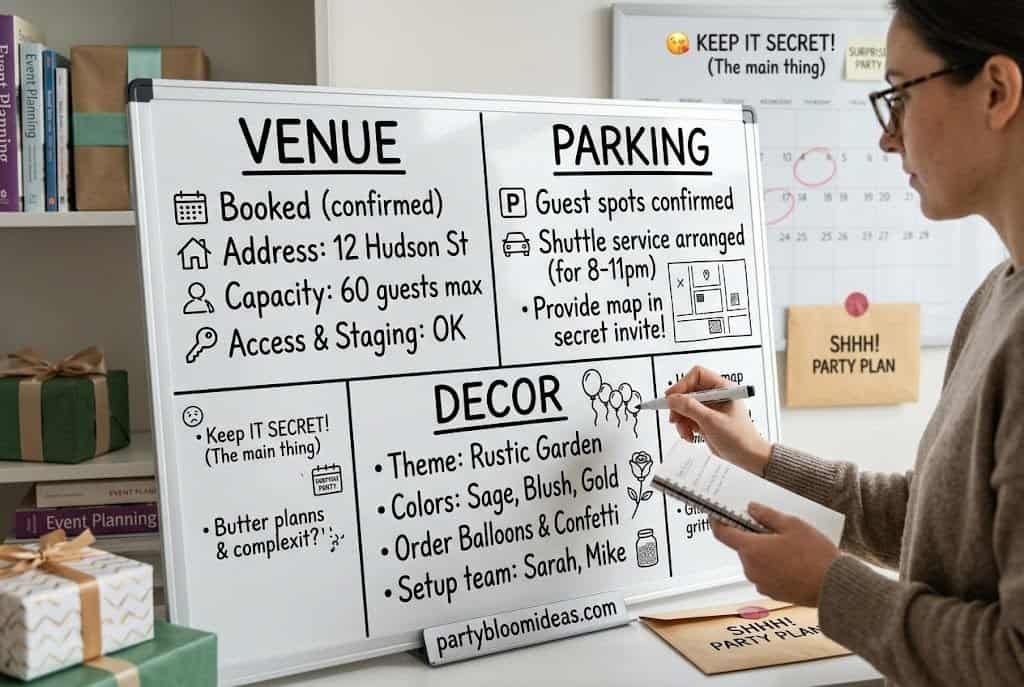
Step 5: Plan Venue, Parking, and Decor
Best for: Hosts weighing venue options; anyone planning a backyard party
Venue choice determines how hard your logistics are. Here’s the honest breakdown:
Restaurant private room: the easiest option. One entrance, staff handles food, you can bring décor, no parking drama outside. This is where I’d start if you’re throwing your first surprise party.
Friend or family member’s home: a solid choice as long as the honoree doesn’t have a habit of dropping by. Emma’s backyard worked because Daniel would never arrive unannounced at his own home through the back gate.
The honoree’s own home: sentimental, but logistically hard. They may arrive early. They may notice their partner acting oddly all morning. If this is your choice, plan a longer decoy and have someone already inside coordinating setup.
PARKING — this is the step everyone forgets until someone texts “where do I park?” with the honoree five minutes away. In your invitation, be explicit: park on Oak Street, park at the shopping center around the block, park at a neighbor’s house. Familiar cars outside announce the party before anyone opens the door.
Decor that works without raising flags:
- String lights already hung from trees or fence ($15–$25 from Costco, installed the night before)
- Votives and candles on tables ($15–$20 from Dollar Tree)
- Photo banner: 20 printed 4×6 photos from CVS ($6) clipped to twine with wooden clothespins ($3) — $10 total, more warmth than anything pre-made
- Balloon cluster at the entrance ($8–$15 in supplies, assembled that morning)
Total decor budget: $50–$75. Honestly, I think elaborate balloon installations for surprise parties are overrated. They require delivery vans, which park outside and announce that something is being set up. Keep decor to things you can carry in a bag.
Step 6: Manage Day-Of Logistics
Best for: Anyone coordinating a surprise party with 15+ guests
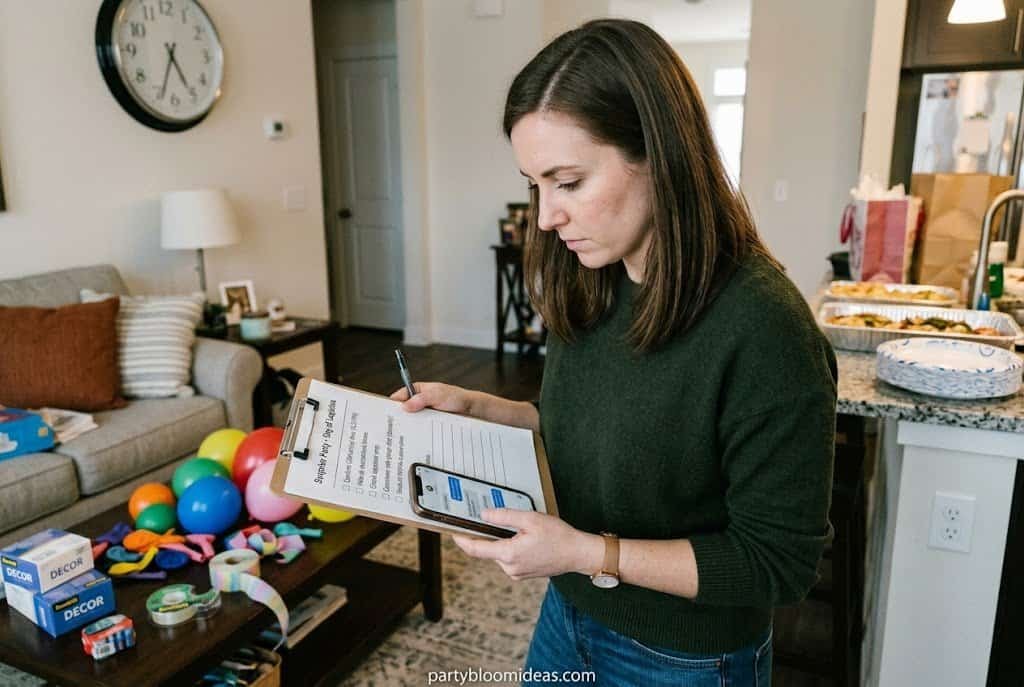
The day of is where everything comes together or starts unraveling at the edges. Assign one person as Day-Of Coordinator — their job is to send WhatsApp updates to the guest group throughout the day:
| Time | Message |
|---|---|
| 10:00 AM | “All on track — see everyone at 6:30 pm.” |
| 3:00 PM | “Reminder: park on Oak Street, not in front of the house.” |
| 5:30 PM | “They’re leaving for the decoy errand now. Arrive by 6:30.” |
| 6:45 PM | “15 minutes out. Inside and quiet — lights stay low.” |
| 7:02 PM | “Pulling up NOW. Silence.” |
This communication chain prevents the thing that will otherwise happen: a well-meaning guest calling the honoree at 6 p.m. to casually ask what they’re up to tonight.
The Lookout is non-negotiable: one person stationed outside, whose only job is to watch for the honoree’s car and signal the coordinator. You need 60–90 seconds of warning — enough time for everyone to get in position, kill the lights, and go quiet.
The reveal layout: guests in an open, visible configuration — not crammed into a hallway or split around a corner. The visual impact depends on seeing everyone at once. Open living rooms, backyard setups, and private dining rooms all work. Long corridors and kitchens with blind corners don’t.
💡 Pro Tip: Brief your venue staff or host on the plan. A cheerful server who walks up to the approaching honoree and says “Oh, are you here for the birthday party?” is not being unhelpful — they just don’t know. Tell them in advance.
According to Eventbrite’s Event Trends Report (2023), social media leaks are cited as the #1 cause of ruined surprise events, with 61% of planners reporting at least one guest posted prematurely. Day-of group communication keeps everyone anchored — and off the honoree’s Instagram notifications.
Step 7: Execute the Reveal (And Let It Land)
Best for: The final moment of any surprise party
You’ve done the work. The guests are in position. The lookout has sent the signal. The lights are low.
Let it happen. Don’t over-choreograph the reveal itself.
The decoy driver leads the honoree through the door. Everyone holds position. The honoree walks in. The lights come up. The room erupts.
Then: give it room to breathe. The first ten seconds belong entirely to the guest of honor. Don’t rush into speeches or cake. Let them take in the room, find the people they love, and have the moment.
After the reveal: hand them a drink immediately. Something to hold helps.
💡 Pro Tip: Designate someone to capture the reveal on video. The expression in those first five seconds — before the honoree has composed themselves — is what they’ll want to watch back. Set a phone on a tripod pointed at the door, or brief a trusted guest to have their camera ready.
By 10 p.m., nobody wanted to leave. That’s the measure of a party done right — not the decorations or the food. The measure is whether people feel somewhere worth staying.

What Actually Goes Wrong: Common Mistakes to Avoid
After helping plan more than a dozen surprise parties, here’s the honest list — not generic advice, but the things I’ve specifically watched derail well-intentioned evenings:
The biggest mistake most hosts make is expanding the inner circle because planning feels lonely. More people knowing feels like more support. What it creates is more unintentional leaks.
- Using Facebook Events — notification risk is real and consistent
- Not briefing guests on parking — familiar cars on the street give it away immediately
- Forgetting the “no social media” request — one tagged story before the reveal ends everything
- Skipping the lookout — without 60–90 seconds of warning, timing falls apart
- Not briefing venue staff — a well-meaning “are you here for the birthday?” blows the whole thing
- Delivery vans arriving close to reveal time — visible logistics announce the party
- Choosing the honoree’s own home without a long decoy — too many uncontrolled variables
9 times out of 10, a leaked surprise traces back to one of these. Not bad luck — an overlooked step.
How to Throw a Surprise Party: Planning Timeline
| Weeks Out | What to Do |
|---|---|
| 6–8 weeks | Confirm honoree would enjoy a surprise. Choose date, time, venue. Build inner circle. |
| 5–6 weeks | Send invitations via WhatsApp. Build decoy plan. Assign lookout, decoy driver, food coordinator. |
| 3–4 weeks | Collect RSVPs. Confirm venue. Order or plan decor. |
| 1–2 weeks | Send reminder with parking and arrival instructions. Reconfirm “no social media” rule. |
| 3–5 days | Brief decoy driver. Confirm food logistics. Remind guests of hard arrival deadline. |
| Day before | Set up any decor that won’t raise flags (string lights, etc.). |
| Day of | Day-Of Coordinator sends hourly updates. Lookout stationed. Food ready before first guest arrives. |
| Reveal moment | Lookout signals. Lights low. Silence. Honoree walks in. |
🎉 Quick Summary
✅ Best for: Milestone birthdays (30th, 40th, 50th), homecoming celebrations, retirement parties, any occasion where the honoree loves being celebrated 💰 Budget range: $75–$400 depending on guest count and venue choice ⏱ Setup time: 6–8 weeks of planning; 2–3 hours of day-of setup 🌟 Top pick: Restaurant private room (easiest logistics, one entrance, no parking risk) 📌 Don’t skip: Assigning a dedicated lookout and putting parking instructions in the invitation
People Also Ask
How do you throw a surprise party without the person finding out? Control information at every step: keep your inner circle to 3–5 people, use a private WhatsApp group instead of Facebook Events, give guests a parking plan and a hard arrival deadline 15–20 minutes before the honoree. The most important element is a convincing, rehearsed decoy plan managed by someone the honoree completely trusts.
What is a good cover story for a surprise party? The most effective decoys are things the honoree already expects or has been looking forward to: dinner at a restaurant they’ve wanted to try, a “casual birthday hangout with a few people,” or a routine errand followed by a meal. The decoy driver must be someone who can stay calm under casual questioning — typically the honoree’s partner or closest friend.
What happens if someone spoils a surprise party? Don’t cancel. Pivot. If the honoree finds out in advance, acknowledge it warmly: “We wanted you to know how many people love you.” The party is still a celebration. Many hosts report that a found-out surprise often results in an even more relaxed, genuinely joyful evening — because the honoree can actually look forward to it.
Is it better to have a small or large surprise party? For the surprise element, smaller is consistently easier: fewer guests means fewer potential leaks, simpler parking management, and a cleaner reveal. The sweet spot is 15–25 guests — significant enough to feel special, manageable enough to execute well. 50+ guests introduces exponential logistical complexity.
How do you manage parking at a surprise party? Include explicit parking instructions in the invitation — a specific street, a nearby lot, or a neighbor’s house. Make it non-optional. Familiar cars outside a venue or home signal that something is happening before the honoree even reaches the door. This is one of the most consistently overlooked steps.
Frequently Asked Questions
How far in advance should I plan a surprise party? For 15–20 guests, 3–4 weeks is workable. For 30+ guests, plan 6–8 weeks ahead — you need time to quietly gather RSVPs, book a venue if needed, and give out-of-town guests enough notice to arrange travel. The more guests, the more lead time you need to coordinate logistics without raising suspicion.
What’s the best way to keep a surprise party secret? Limit your inner circle to 3–5 people who know the full plan. Use a private WhatsApp or iMessage group — not Facebook Events. Give all other guests only what they need: where, when, what to wear, and the “no social media” rule. Avoid naming the group chat or any email thread after the honoree.
How do I get the guest of honor to the party without them suspecting? Create a convincing decoy — a believable reason to be at or near the venue at the right time. The most successful decoys are things the honoree already expects: a favorite restaurant, a casual birthday dinner for four, or a simple “let’s get out of the house” suggestion. Rehearse the story with the decoy driver beforehand, out loud.
What do I do if the guest of honor finds out early? Don’t cancel. Pivot to a “semi-surprise” — they know people are coming, but they don’t know who or every detail. Or continue as planned: the party is still a celebration, and the effort behind it still communicates love. A good recovery line: “We just wanted to show you how many people care about you.”
Is a surprise party a good idea for an introvert? It depends, but 9 times out of 10 — if someone is a genuine introvert who has previously said they dislike being the center of attention, a surprise party will cause stress rather than delight. Ask their closest friends first. If there’s real uncertainty, tell them in advance. A celebration they can mentally prepare for is still a meaningful celebration.
What’s the best venue for a surprise party? A restaurant private room is the easiest: one entrance, staff handles food, no visible parking outside, and you can still bring your own décor. A friend or family member’s home works well if the honoree doesn’t have a habit of dropping by unexpectedly. Avoid the honoree’s own home unless you have a long decoy plan and a coordinator already staged inside.
How do I handle late guests at a surprise party? Build in a 15–20 minute buffer: tell guests to arrive by 6:30 if the honoree is expected at 6:45. Be direct in the invitation: “Guest of honor arrives at 6:45 — please be inside by 6:30.” If a guest is running late, the Day-Of Coordinator manages it in the group chat. Guests should never call or text the honoree to check their plans.
Should I use evites for a surprise party? Paperless Post or Evite can work if you confirm invitations go to email addresses the honoree doesn’t have access to and the platform won’t auto-notify mutual contacts. WhatsApp groups are generally safer and more controllable, and most friend groups are already using them.
How many people should be in the inner circle for a surprise party? 3–5 people maximum who know the full plan: venue, decoy, timing, guest list. All other guests get a need-to-know briefing — where, when, what to wear, and that it’s a surprise. The fewer people who hold the complete picture, the fewer potential leaks.
What food works best for a surprise party? Food that doesn’t require on-site cooking or last-minute heating. Restaurant pickup at $15–$20 per person, pre-ordered grocery deli trays, or dishes fully prepared 2+ hours before guests arrive all work well. Avoid catering deliveries close to reveal time — the van sitting outside announces that something is being set up.
How do I tell guests to arrive early without tipping off the guest of honor? In the invitation, be direct: “Guest of honor arrives at 7:00 PM. Please be inside and settled by 6:30 PM.” Most guests understand without needing further explanation. For anyone who asks why, the answer is simple: “We need everyone in position before they arrive.”
What’s the hardest part of planning a surprise party? Managing communication — not the venue, not the décor, not the food. The hardest part is controlling who knows what, preventing accidental leaks, and keeping every guest on the same page on the day of. Communication discipline is what separates a successful surprise from a failed one.
How do I keep guests from posting on social media before the reveal? Put it in the invitation explicitly: “No social media posts until after the reveal — thank you!” Repeat it in the day-of group message. If you have a known over-poster in the group, mention it to them directly and individually. According to Eventbrite’s 2023 data, social media posts are the #1 cause of ruined surprise events — this note takes thirty seconds to add and saves everything.
Can you throw a surprise party on a tight budget? Absolutely — and some of the most memorable ones are done on very little. A photo banner from CVS prints and Dollar Tree twine costs about $10. String lights from Costco run $15–$25. Candles for 6 tables from Dollar Tree cost $15–$20. Total decor: $50–$75. Put your budget toward food and the experience — the reveal moment itself costs nothing.
Conclusion
A successful surprise party isn’t about expensive decorations, elaborate themes, or a huge guest list—it’s about creating a meaningful moment that makes someone feel genuinely loved and appreciated. The secret to pulling it off lies in careful planning, clear communication, and protecting the surprise until the very last second.
By keeping your inner circle small, creating a believable decoy plan, managing guest logistics, and preparing for the reveal, you dramatically increase your chances of delivering a memorable experience that your guest of honor will never forget. Whether you’re planning a milestone birthday, retirement celebration, homecoming, or special achievement party, the goal remains the same: bringing together the people who matter most to celebrate someone special.
At the end of the day, guests may forget the decorations or what was served for dinner, but they’ll remember the laughter, the emotions, and the look on the honoree’s face when they walk into a room filled with people who care about them. That’s what makes a surprise party truly unforgettable.
Read More :
20 kids Birthday Party Themes
10 Graduation Party Ideas (2026)
4th of July Party Ideas That Are Red, White, and Unforgettable